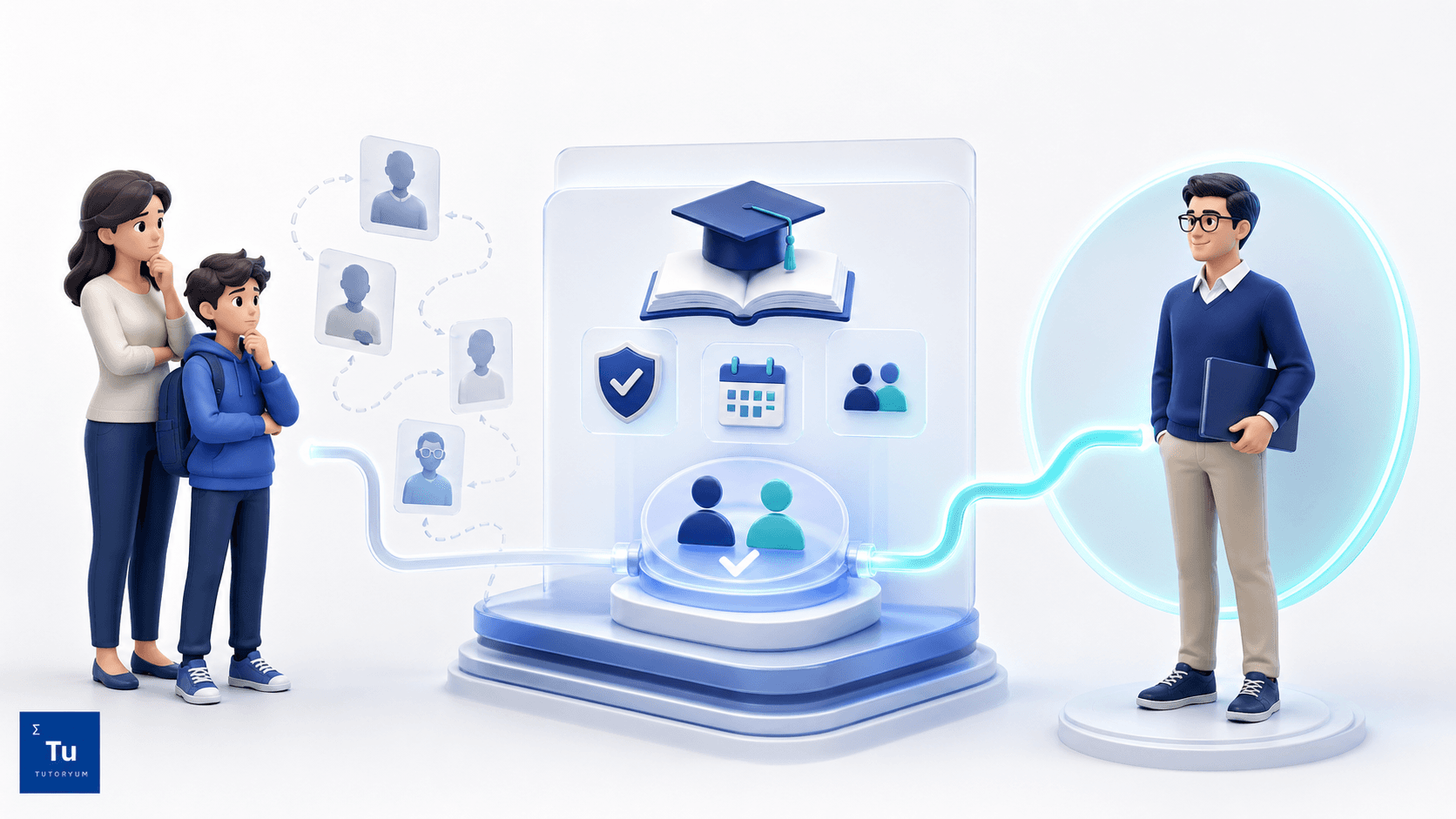
We're building Tutoryum because private education still suffers from weak discovery. Even when good tutors exist, students and parents often struggle to find the right one with enough confidence and clarity. The process remains too fragmented, too referral-dependent, and too difficult to compare well.
Why private education still feels inefficient
Private education is not a small or niche category. It is active, important, and deeply personal. But the systems around tutor discovery often remain underbuilt.
Many users still rely on:
- personal recommendations
- scattered listings
- incomplete profiles
- back-and-forth messaging
- late-stage price discovery
- unclear availability
That means a major decision is still being made through a process that is often informal and inefficient.
Why this is not just a convenience problem
Choosing a tutor is not like choosing a generic product. The decision often affects:
- academic progress
- parent confidence
- time use
- financial efficiency
- long-term learning continuity
A weak discovery process does not just create inconvenience. It creates poor educational matching.
That makes the problem worth solving properly.
What is missing from the current market?
The biggest gap is not simply supply. It is decision infrastructure.
Users need more than a list of tutor names or subject tags. They need a platform that makes key judgment factors easier to understand:
- level fit
- teaching relevance
- availability
- trust
- price structure
- learning context
Without these, the market remains noisy even when it appears digitally active.
Why referrals still dominate
We are building Tutoryum partly because referrals still carry too much weight in tutor selection. Referrals exist for a reason: they reduce uncertainty.
But they also create problems:
- they narrow the visible market
- they reward network proximity over platform clarity
- they reduce discoverability for strong tutors outside a user's circle
- they make scaling trust harder
A better platform should not try to erase trust. It should make trust more accessible and less dependent on who already knows whom.
Why this matters for tutors too
The problem is not only on the demand side. Good tutors also need better market infrastructure.
In many systems, visibility is not distributed fairly. Tutors with stronger personal networks may be easier to find than tutors with stronger educational fit. That creates inefficiency for everyone.
Tutoryum is meant to support better discovery on both sides:
- better tutor selection for students and parents
- better visibility conditions for qualified tutors
Why Kapseller sees this as a strong platform opportunity
Kapseller builds matching infrastructure in markets where discovery and coordination are still weak. Private education is one of the clearest examples.
The problem is not that private education is offline. The problem is that its digital systems often still behave like shallow directories rather than strong matching environments.
Tutoryum is being built to change that.
We're building Tutoryum because private education still relies too heavily on fragmented information, weak comparison, and personal referrals. The goal is not just to put tutors online. It is to create a better decision environment for finding the right tutor in the first place.