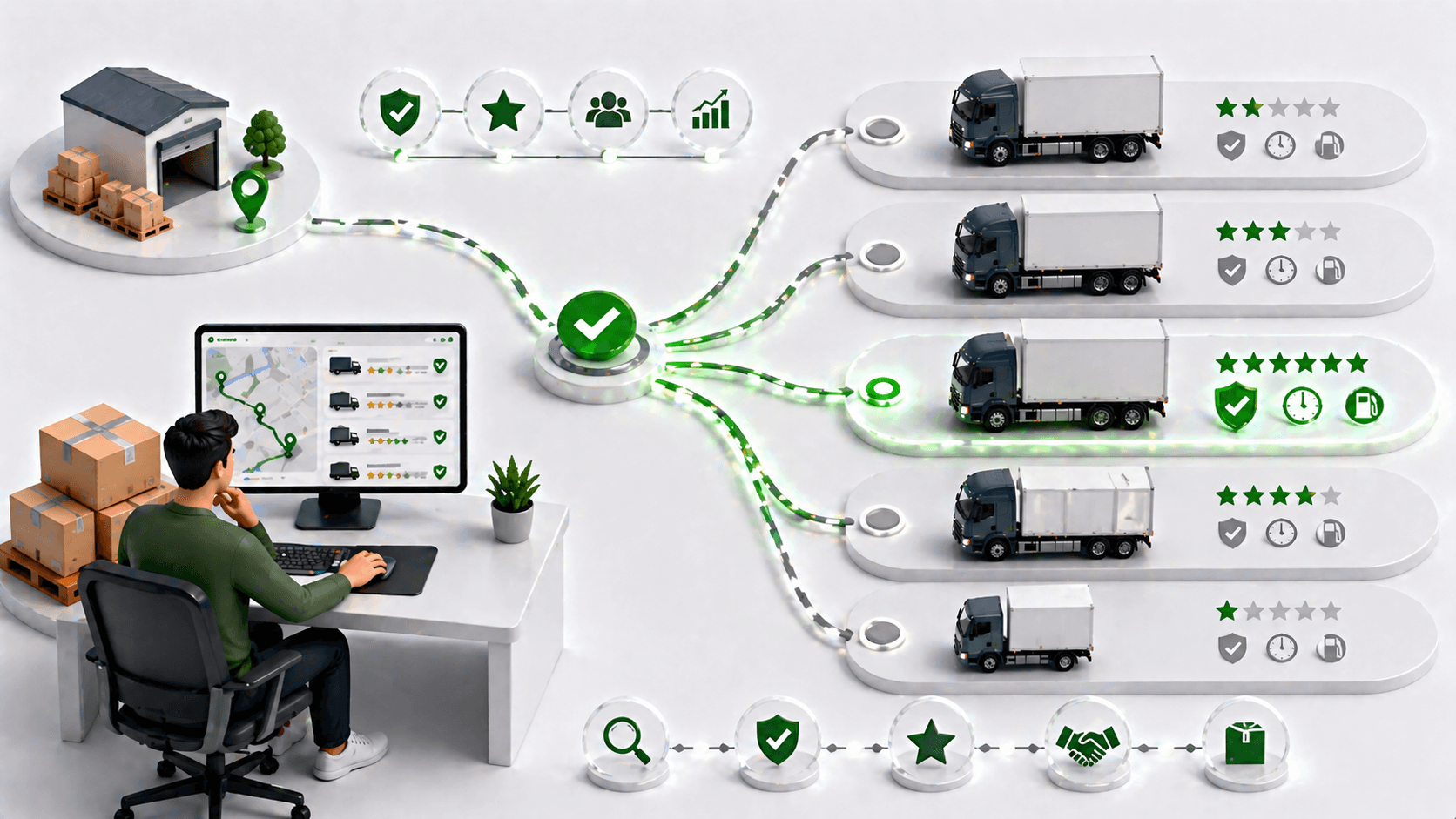
Access to better-rated carriers should be easier because quality signals are only useful when they improve actual decisions. If a logistics platform shows ratings but does not make stronger carriers easier to identify and act on, then the trust layer remains too passive. Better-rated carriers should not just be visible. They should be more meaningfully accessible within the decision flow.
Why ratings are not enough on their own
Many platforms display ratings as if their mere presence solves the trust problem. It does not.
A rating becomes useful only if it helps users answer practical questions such as:
- Which carrier deserves more confidence?
- Which option is more reliable for this context?
- Which choice should I prioritize first?
- Which signal actually reduces my uncertainty?
If ratings are present but weakly connected to access and action, they become decorative rather than decisive.
Why easier access improves decision quality
Easier access to better-rated carriers can improve decision-making by:
- reducing search effort
- surfacing stronger trust candidates faster
- improving comparison quality
- decreasing ambiguity
- helping users act with more confidence
This matters because users should not have to work excessively hard to benefit from the platform's quality signals.
A strong trust layer should lower decision cost, not leave users to do all the interpretation alone.
Why this matters for market behavior
When better-rated carriers are easier to access, the platform does more than improve user convenience. It also creates stronger market incentives.
That can help:
- reward stronger performance
- improve the visibility of reliable operators
- make trust signals more economically meaningful
- reinforce better service behavior over time
In other words, easier access to higher-quality options makes trust matter more in practice, not just in theory.
Why weak access weakens the rating system itself
If high ratings do not lead to better visibility or easier action, participants may stop treating ratings as meaningful. Users may conclude that:
- ratings do not really influence outcomes
- quality is hard to act on
- the platform is not structured around good decision-making
That weakens trust not only in carriers, but in the platform itself.
A trust signal that does not shape access becomes less credible over time.
What platforms should do differently
A stronger logistics platform should not just expose rating data. It should make quality easier to use.
That may include:
- better prioritization of stronger options
- more context around what the ratings mean
- better integration of quality into comparison flows
- stronger clarity around why one carrier may deserve more confidence than another
The point is not to make ratings absolute. It is to make them operationally useful.
Why this matters for Tasio
Tasio is built around the idea that visibility and coordination should become more useful, not just more digital. Trust is part of that. If carrier quality is visible but hard to act on, then the system is still underperforming.
Better-rated carriers should therefore become easier to recognize and easier to move toward in a meaningful logistics workflow.
Access to better-rated carriers should be easier because trust signals only matter when they improve decisions. A strong logistics platform should not merely display quality indicators. It should help users act on them more effectively. That is how trust becomes part of infrastructure rather than just part of presentation.